
Lilly and I take in a beautiful fall day.
Category: Uncategorized
Vlog #4 – Art Therapy
When the creative impulse strikes, indulge it without judgement.
First Look at New Unmasked Book Trailer
My patrons get the first look at my new book trailer. This was created by Mers from Harpies in the Trees.
Sound file by: tearing paper_10.wav by Dymewiz on Freesound.org
Vlog #3 – Finding the Old Carousel
Checking out the old Willow Grove Park as research for my new novel, Carni, about an abandoned haunted carnival site.
Write The Next Sentence

Working on a new novel is always a bit destabilizing. You start off with what you think is a good idea, hopefully enough to galvanize the process, but then you reach the dreaded three-quarter section slump. My novels do tend to be on the shorter side, but I don’t see this one concluding for another twenty thousand words or so. I know where I want the story to get to, sort of, but how to get there?
While procrastinating before my morning writing session waiting for the caffeine to kick in, I often amuse myself by watching YouTube writing videos. There are some good ones out there, as well as some really bad ones whose advice you should never take. But among the videos I do find useful are the ones by Dean Wesley Smith. I’ve mentioned him before; the reason I like his advice is that he’s a pro who’s been there. He also put the idea of “writing into the dark” in my head. I read his short book on the topic, but honestly, you can glean enough from the videos to get the message.
I’ve written the past two novels, including my current draft, into the dark and I will probably never go back to outlining again. It’s not an easy process, but it’s a much more creative one. By not knowing what is going to happen next in my story, I am tapping into my creative brain, not the critical one. Now, that doesn’t mean a writer can’t get extremely creative inventing an outline, and I have approached writing that way in the past. But if all the creativity is spent on the pre-write, then isn’t getting the words down just an exercise in filling in the blanks? Many successful writers, I imagine, prefer outlining, but I’ve found it much more satisfying—and scary—to write into the dark.
As I approached this morning’s writing session feeling my way around blindly, hoping to grasp something familiar that will guide me to the light of sudden inspiration, that “aha” moment every writer lives for, I took Smith’s advice to not think too far ahead. Just write the next sentence and then write the next one.
So, I did that until I had written 1700 words in less than an hour. I feel pretty good about it, and not only that, during my writing into the dark session I found an entry point to the next scene I hadn’t thought of before. This is the value, and the joy, of discovery writing. It’s the essence of creative writing. When you get stuck, just write the next sentence.
It worked for me. If you’ve ever tried this approach or if you’re dead set against it, please leave a comment below. I’d love to hear your thoughts on the subject.
For weekly vlogs on the creative process, including writing into the dark, consider becoming a Patron.

Vlog #2 In the Field (literally)
Researching locations for my new novel, Carni, and checking out the aftermath of a tornado.
Vlog #1 – The Halloween Store
Spooky Season is here! I’m hitting the Halloween store early to get my costume ready for my Regina’s Haunted Library Halloween Special.
Storms and Melodramas!
I am almost through reading the Landy Series by V.C. Andrews (ghostwritten by Andrew Neiderman). In one of the series’ most dramatic scenes (spoilers), the teenage protagonist gives birth while a hurricane rages outdoors, threatening to tear the Bayou shack down around the heroine’s ears. Just as I was reading this harrowing chapter in book two, Pearl in the Mist, real-life hurricane Ida was tearing through New Orleans sixteen years to the date of Hurricane Katrina’s devastation. Luckily, this time the levees held.
As the storm moved north, I became more absorbed in my V.C. Andrews’ melodrama and less interested in following the weather report until I received the first-ever tornado warning on my iPhone.
What? Tornado? The only time I’ve ever confronted a tornado was during my annual viewing of The Wizard of Oz.
Laughing off my concerned friend’s “Go to your basement now!” text (my basement’s nasty), I obliviously returned to the next paperback in the series with its nifty step-back cover. The flickering chandelier lights and rain-lashed windowpanes added to my enjoyment. I only hoped the electricity would remain on until I got to the end of the chapter where the heroine was being chained to a bed in order to be raped by a drunken lout.
I was riveted, quite oblivious to the fact that a tornado was, indeed, about to rip through my town. The first image is about two miles from where I live and the second is only three blocks. Yeah, it was that close.


Yesterday, my husband and I trekked down the Delaware River banks to observe the damage at the bridge. It was humbling to see the evidence of Nature’s wrath, her ability to render tall young trees into scattered timber.
Despite the da nger, there is something about storms that always invigorates my spirit, provides grist for my poetry. Here is an example.
Perhaps I’d view storms less romantically if it were my roof laying on the street. But somehow I doubt it. Storms—like highly operatic melodramas—ease my own interior chaos like nothing else.
However, the next time my phone alarms with a tornado warning, I will take my friend’s advice and bring my book, my candles, and my loved ones down to my nasty basement. As much as I adore storms, I’d rather not star in my own melodrama.
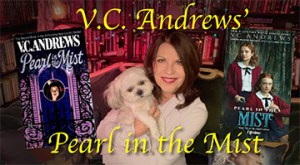
Speaking of melodrama, here is my spoiler-ridden discussion of V.C. Andrews’ Pearl in the Mist. I am working my way through all of the V.C. Andrews series and loving every minute of it. If you’re a V.C. Andrews fan, please let me know in the comments below. I would love to hear your thoughts.
On a different note, I just started a Patreon to help support my writing and my YouTube channel. My patron perks include weekly vlogs, ebooks, merch, and even personalized tarot readings by our own Batilda Belfry so please give it a look.
Whatever Happened to Gothic Romance?
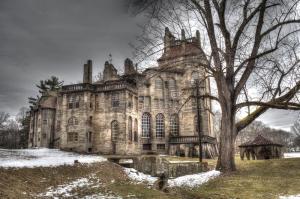
I loved visiting my Aunt Rita when I was a kid. Her little brick house in Doylestown, PA was not only warm and cozy, it was also a few blocks away from a castle. Seriously, it’s called Font Hill, and here is a photo of it.
Widowed at a very young age, my Aunt Rita was a single mother who developed her talent for art, music, gardening, and pop psychology. She was also an avid reader. Every visit to her house was an exercise in art emersion and mind expansion. It was also the place where my much older teenage cousin kept a store of great rock albums, Mad Magazines, and underground comics, but that’s for a different blog topic.
One thing I loved to do whenever I visited her house was read from her seemingly never-ending stack of Gothic romance books. As a collector and reader of this brand of pulp fiction, I often wonder why the genre fell out of favor with readers. Or did it just evolve into Anne Rice and Stephenie Meyer? I enjoy Twilight, but somehow, the Cullen’s high-tech Washington home does not manifest the same chills as Wuthering Heights or Manderley. Nor can their mountain-top vampy ball games compete with bareback rides through the moors. I still long for the girl running away from the castle.
It is generally agreed that the Gothic literature genre began with Horace Walpole’s 1764 novel, The Castle of Otranto. From there, the blackened vine wove its way through Ann Radcliffe and the Brontes. But what we know as modern Gothic romance probably began with Daphne DuMaurier’s Rebecca.
The distressed heroine is so meek she isn’t even named in the novel, and yet her goodness wins out against the “ghost” of wealthy Maxim DeWinter’s beautiful and accomplished former wife. The sweeping English estate, Manderly, is as much of a character as any other.
Recently, while preparing to write in the classic Gothic romance genre, I consulted a book written by Dean Koontz about the craft of genre writing. The book came out in the mid-70s, so much of it was outdated, like what is the ideal typing paper to purchase. But I took to heart his advice about not veering too far from the expected tropes. These include the virginal young governess type who arrives at the estate to fulfill some job. She is often an ophan, impoverished, but dignified and smart. Her status at the estate is far below the owner, but one step or more above the domestic staff which usually includes a hostile housekeeper. Mrs. Danvers exemplifies the trope perfectly. The lord of the manor is the Byronic hero personified. He is remote but charming. His reputation is stained from some past indiscretion. He is the subject of local gossip. The nearby village of “common folk” is often featured as a homey contrast to the corrupting influence of the grand estate. As our heroine attempts to perform her job, creepy supernatural events cause her to question her dashing but dangerous employer and inadvertently lead her into his arms.
In his chapter on Gothic romance, Koontz stressed that the “love scenes” should never go past gentle kisses and brief caresses and that the heroine should not be the “women’s lib type” because she will turn off readers. Interesting.
Perhaps the best primer in Gothic romance comes from the TV sensation Dark Shadows. Even before Barnabas Collins makes an appearance, young governess Victoria Winters grapples with the strange events at Collinwood, and soaks up some local color at the Blue Whale. I collect and read the accompanying books written by Marilyn Ross (W.E.D. Ross, the prolific genre writer) and they follow Koontz’s checklist to a T.
Did the Gothic romance genre evolve into domestic noir such as Gone Girl and The Girl on the Train as the article listed below suggests? Possibly.
The 2020 release of Mexican Gothic by Silvia Morena-Garcia offered high hopes for a return of the genre. Although the book was well-received, I found it lackluster. By making the heroine a “strong female character ” who pushes back against the patriarchy instead of focusing on her vulnerability and inner strength to overcome the doom-filled environment, the author missed the mark. In that respect, I think Koontz was right.
I attempted in my own way, to meet the criteria of the genre in my recently completed Gothic romance novella, Ravenscroft Hall. Read if for free on Wattpad.
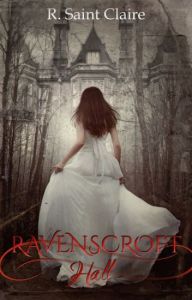
I made this video a while ago. My obsession continues. If you’re a fan of Gothic Romance, please comment below with any of your favorites.
Additional reading:
The Girl in the Mansion: How Gothic Romances Became Domestic Noirs
New Novel Inspirations – Carnival Horror
The new novel I’m working on, titled Carni, will be my first attempt at writing carnival horror, a sub-genre that includes killer clowns, freak shows, and tunnels of love leading straight to hell.

My story is set in South Jersey, specifically Burlington Island, 300 acres of wilderness wedged in between Jersey and PA on the Delaware River. The island has an interesting history that I’m using as a springboard for my creepy carnival story.
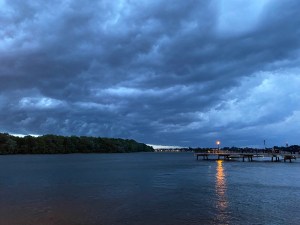
Called Matennecunk by the Lenape natives, the island became the location of New Jersey’s first recorded murder when two Dutchmen were slain by Lenape braves in 1671. No, my story will not include an “old Indian burial ground” filled with vengeful ghosts. I think that cliché has been done to death by now. That’s not to say I won’t be using established genre tropes because I always do. Creepy clown anyone? But I will be attempting, in my own way, to give them a fresh merry-go-round spin.
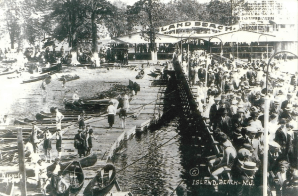
What inspired my story, besides the island itself, was that it was once the location of an amusement park called Island Beach. Judging by the old photos, it was quite a popular attraction. A fire in the 1920s ended the fun, however, and the island changed hands and purposes. It is currently owned by the state of New Jersey and is used for mining sand and gravel, thus the man-made lagoon at the island’s center. Clean-up efforts persist to this day, as do occasional exploration into the rusty relics of the island’s past lives. I’ve never set a foot on its banks, but I hope to soon. I want to absorb its essence for my story. I’ll probably absorb plenty of mosquito bites and Poison Ivy as well, but it’s all in a day’s work.
I begin my story with the fire at the carnival and who set it (all fictional). 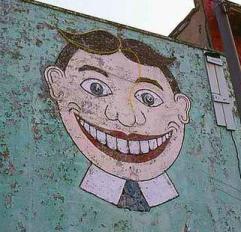 My villain is the Island Beach mascot called Carni, a killer clown inspired by Coney Island’s Steeplechase Jack—can’t tell me that grin isn’t creepy, and Alfundo, the Dorney Park mascot featured on this wonderful sign I remember from visiting Dorney as a kid. A fire in the mid-1980s destroyed most of Dorney’s original small-town charm, but the park is still there.

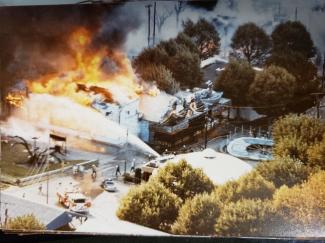
Creaky wooden rides erupting into sudden flames, roller coasters becoming derailed, creepy clowns with Glasgow grins, that persistent legend of the kid who lost his arm in the fun-house machinery—these are what adds those extra chills to the carnival thrills. As part of my story mapping, I’m not only recalling my own fond memories of being deliciously scared at carnivals and amusement parks, but I’m also revisiting some carnival-themed works like Dean Koontz’s The Fun House and classic horror films like Freaks and Carnival of Souls. From the unsettling strains of the calliope to the rough-trade roustabout who just might mess with the gears on that ride, there is always danger lurking within, and just outside, the midway’s colored lights. Isn’t it fun!
My latest video, adding to the discussion.

 R. Saint Claire