It was a read-a-thon challenge on BookTube, #HorrorMAYhem if you’re curious, that finally nudged me toward reading a classic story burning up my library shelf (and Kindle Fire) for years. Maybe I resisted reading Carmilla because I was under the delusion that I had read it before—that was actually Coleridge’s Christabel. So, during my yearly creative retreat at a lakeside cabin in the woods, I finally cracked open my vintage paperback copy and took a bite. 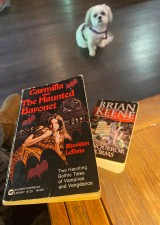
Carmilla, the 1872 novella written by Irish author Sheridan Le Fanu, burst in my mouth like the wild red berries I’d indulged in during my morning hike—more bitter than sweet, but delicious.
Perhaps my resistance also had something to do with a belief that I needed a proper setting in which to absorb the story. After all, we live in a world of distractions that makes focusing on anything a challenge, let alone dense, Victorian prose. I had just completed Brian Keene’s The Conqueror Worms for Week One of the reading challenge, the assignment being supernatural creatures. After Keene’s gory gut punches, it took me a few paragraphs to adjust to Le Fanu’s writing style. Still, with only the music of birdsong—including a pair of owls outside my cabin—and soft breezes to accompany my reading, Carmilla stirred my blood in ways I hadn’t experienced in a long time.
Several adaptations, including a wonderfully cheesy Hammer film, have seized on the titillating “lesbian vampire” theme. Yes, the theme is there and it’s quite subtle (more Sappho than Sade), but my deep reading yielded so many more delights. For one thing, the setting could not be more Gothic. The story takes place in Styria, which a quick search on my phone informed me is part of Austria. Austria is a place I’ve always wanted to visit; my grandfather was born there, and I’ve only heard about its natural beauty and stunning architecture through stories and films. This setting is in the remote country, a lonely and primitive place, where English ex-pats can afford to live like kings and queens on modest yearly incomes. But the quiet beauty is haunted by the ghosts of an old aristocratic family, the Karnsteins, their lineage now reduced to mouldering tombs in a roofless church and an equally-desolate château which, in the thick of the forest, overlooks the silent ruins of the town.
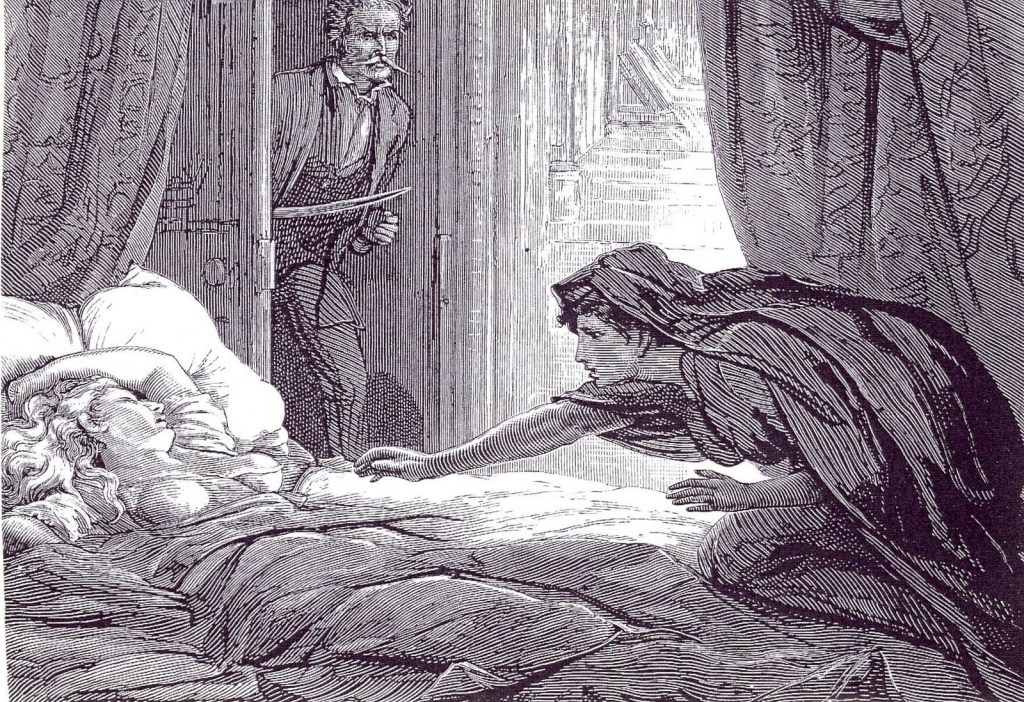
The ancient estate (or schloss) the young heroine, Laura, and her father inhabit has a moat, a drawbridge, and so many rooms (replete with secret passages) that one’s screams in the middle of the night are undetected by other household members, as Laura discovers when at six years old she is attacked by a ghostly nocturnal visitor. This strangely beautiful lady-phantom kisses and caresses Laura in a way the motherless child finds comforting until she shocks her by penetrating her chest with two sharp needles. While Laura screams for her governess, the phantom disappears beneath the bed (a creepy image indeed). Later, she will return in the guise of a cat during her attacks.
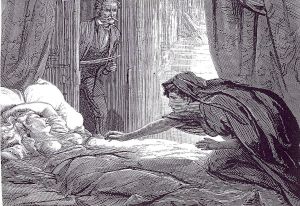
Laura, now a young lady of eighteen at the time of the narrative, is still disturbed by the incident from her childhood. Will this strange apparition come back to haunt her? We know it will.
A dramatic opening scene sets the stage when young Laura, her father, and a few servants take a moonlit stroll and witness a carriage with footmen in full livery crash against a tree and overturn. The team of horses shied at the site of an ancient cross on the estate—someone remarks in a chilling bit of foreshadowing. A noblewoman dressed in black velvet, a turbaned woman within the carriage grinning derisively toward the ladies, and ugly, hang-dog looking grooms hint at the evil lurking beneath the gilded veneer.
In a rushed moment of chivalry, Laura’s father decides to let Carmilla, stunned in the carriage accident, remain at his estate until the mother can reclaim her in several months’ time. The plan is vague and not very well thought out, but Laura is happy to have a new friend even if the new friend is a bit…strange.
Carmilla is pale, languid, rarely eats except to nibble on some chocolate, and sleeps most of the day. She is also “abnormally” affectionate toward young Laura, caressing her and proclaiming her love with rapid breaths and a heaving bosom. Laura finds her young companion’s romantic expressions, like great beauty, both seductive and repulsive. Still, she’s inexplicably drawn to her.
Despite her sweetness and languor, Carmilla occasionally flames with the imperious indignation of a Countess Bathory. When a grotesque peddler shows up with some bizarre taxidermy of various animals stitched together and suggests grinding down Carmilla’s unusually sharp teeth, Carmilla retorts: “How dares that mountebank insult us so? Where is your father? I shall demand redress from him. My father would have had the wretch tied up to the pump, and flogged with a cart-whip, and burnt to the bones with the castle brands!”
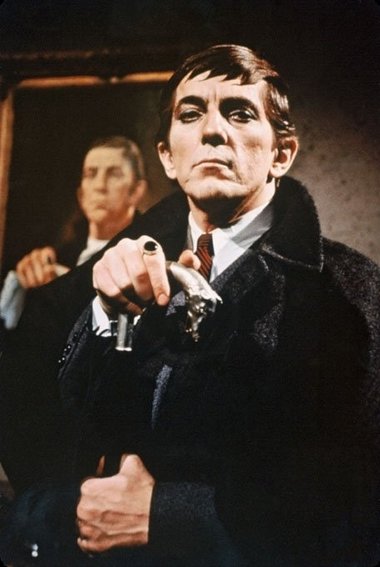
I recognized in this early work of vampire fiction many subplots and characters recycled in every Gothic vampire story from Dracula to Dark Shadows and beyond, including midnight gallops, country doctor visits, superstitious common folk, misty graveyards, and even a Van Helsing character who shows up at the end with his “tool kit” to dispatch Carmilla, really the two-hundred year old Countess of Karnstein, with a stake through the heart followed by decapitation for good measure.
Glued to the page, I sucked down every word of this Gothic tale, and when I finished, my bosom heaved for more. In fact, I’d barely read the last line when I fired up my iPhone and listened to the audiobook while sitting by the lake, pretending I was in Villa Diodati. Like other favorite Gothic classics, Jane Eyre and Frankenstein among them, I will revisit this novella many times hence.
With my bloodlust for Carmilla unsated after two successive readings, I desperately searched for some film adaptations. Carmilla, a recent film written and directed by Emily Harris, is an atmospheric interpretation of how a sexually-repressed governess takes out her frustrations on the budding Sapphic romance between her teenage charge and her mysterious new friend. The film is pretty and meant to be poignant, but I yawned through most of it. I wanted more of Carmella’s fierceness, and I almost found it in The Vampire Lovers (1970), the first in a Hammer Film trilogy starring Peter Cushing. Here, you’ll find more boobs than blood. The late 60’s hairstyles and make-up had me giggling, but at least it stuck close to the original plot. I plan to watch the entire trilogy this weekend.

Perhaps a definitive adaptation is out there. I’ll continue to search. In the meantime, Carmilla will haunt my dreams most deliciously. Feeling refreshed from my cabin retreat, a sweet female cat showed up on my doorstep when I returned home. She purred and threaded through my legs when I petted her and has shown no intention of leaving.






 R. Saint Claire